
A Good Specification: Where Successful Automation Begins
Göncző József ·
Reading time: approx. 12–15 minutes
The investment that is decided on paper
In today's industrial automation market, the question is no longer whether a process can technically be automated. The technology – whether collaborative robots, high-speed SCARA arms or camera systems supported by neural networks – is available.
The real question is:
- whether it is worth doing,
- whether it pays off,
- and what exactly we expect from it.
The success of an automation project is not determined by the brand of the robots installed, the shine of the control cabinet or the number of lines of program code. Success rests on an invisible foundation made up of three inseparable pillars:
- a precise specification,
- purposeful functionality,
- and a return on investment based on numbers.
This article guides you along the path of turning technological uncertainty into a predictable business result.
I. The problem: when technology gets ahead of the plan
Ad hoc robotisation is a common phenomenon in both the Hungarian and the international industrial environment. The company's management recognises a labour shortage or a rising scrap rate, and the reflex response is:
– Let's buy a robot!
This approach, however, has several serious flaws:
- The missing "what": Without a specification, the physical constraints only come to light in the middle of the development phase (e.g. the machine does not fit in the hall, the cycle time is 2 seconds longer than required, or the number, payload or working range of the robots is inadequate).
- Cost explosion: Any modification that would have taken 5 minutes and cost nothing on the drawing board can cost millions and weeks in the execution phase.
- Lost trust: If the first robot cell does not live up to the expectations placed in it, the organisation's resistance to future developments grows.
A project started without a specification is like starting to build a house without a blueprint: in the end there will probably be a roof over our heads, but the door will not be where we wanted it, and it will cost twice as much.
II. The specification: the blueprint of the project
From a professional point of view, the specification is not a wish list but the "contractual basis" of the project. It is the document that brings the customer's needs and the integrator's engineering solutions into a common language.
1. URS (User Requirement Specification) – the "what"
This document records the user's expectations. Here we are not talking about the solution, but about the task:
- Production capacity: What is the expected output per shift?
- Quality requirements: Within which tolerances must the process stay?
- Product changeover: How is the changeover carried out and how long is it expected to take?
- Environmental conditions: What dust, humidity and temperature effects may the system be exposed to?
- Availability: What is the expected operational reliability (e.g. 98%+)?
- Level of automation: Should the machine be manual, semi-automatic or automatic?
- Safety and standards: Which regulations (e.g. CE, internal standards) must be complied with?
- Data handling and IT: Is data collection or a MES/ERP connection required?
- Operator interface: What is the language of the operator interface and what are its authorisation levels?
- Space requirement: How much physical space is available for the machine?
- Power supply: Which supply sources (V, bar) are available on site?
- Requirements for commercial components: Are there preferred suppliers? (e.g. only Siemens PLC, SMC pneumatics, Rittal cabinets).
- Type of interaction: Fully separated, sequential (alternating work) or cooperative?
- Body dimensions and proportions: For operators of what height must the workstation be dimensioned?
- Load limits: How much weight does the person have to move during the process?
2. FDS (Functional Design Specification) – the "how"
This is the engineering answer to the URS. It describes the logical structure of the system:
- Which sensors trigger the motion?
- How does the system handle defective workpieces (rework or scrap)?
- Which algorithms control path planning?
- Description of the manual, automatic, service and cleaning modes.
- What data do we send to the ERP, and in what format?
- How does the system react to unexpected occlusions caused by human movement (sensor coverage)?
- How does the machine signal the next move to the person (e.g. light signal, projection)?
Many companies only plan the motion of the machine. We simulate the entire cell, including the space in which the human workforce moves. This avoids discovering at commissioning that the machine is fast, but the operator cannot reach the workpiece or is constantly blocking the safety scanner.
In our experience, one of the most important parts of a good specification is the handling of "unexpected events". What happens in the event of a network failure? How should the machine behave if the operator opens the door to the safety zone? If there are no answers to these questions recorded in advance, the development engineer will improvise under deadline pressure, at the expense of safety and efficiency. Our suggestion: contact us even before the specification is drawn up, and we will help you write it.
III. Functionality: the trap of excessive complexity, and modularity
In automation it is easy to fall into the trap of the "machine that can do absolutely everything". Excessive complexity, however, not only makes the project more expensive, but also increases the number of potential failure points.
The principle of necessity and sufficiency
When designing functionality, the question must be asked: is this extra function really necessary for the return on investment?
- Modularity: Design the system so that it can be extended later, but do not pay today for options that would only be used several years from now.
- Interfaces and Industry 4.0: In today's world a machine cannot be an island. The specification must record how the system communicates with the existing production line or with ERP/MES systems. Use standard protocols (e.g. Profinet).
- Ergonomics: Serving and maintaining the robot should not be a struggle. A badly placed sensor that can only be accessed with two hours of disassembly, or a robot installed in the wrong position, can ruin the project's efficiency figures.
IV. Return on investment (ROI): more than the labour costs replaced
Financial decision-makers often calculate only with the formula "how many people's work does the robot replace". But that is only the tip of the iceberg. The real return on investment (ROI) is far more complex:
- Quality improvement: The robot does not get tired, and its hand does not tremble even in the 480th minute. A lower scrap rate directly increases profit.
- OEE (Overall Equipment Effectiveness): The cycle time improvement recorded in the specification frees up extra capacity, making it possible to fulfil more orders on the same floor space.
- Risk reduction: A robot working in a hazardous or monotonous environment reduces the likelihood of occupational accidents and staff turnover. Avoiding a machine crash – guaranteed by collision protection – can in itself save millions.
- Energy efficiency: Modern drive technology and optimised motion profiles (e.g. regenerative braking in the case of AMRs) significantly reduce operating costs.
V. The solution: Robot-Service experience and the practical path
At Robot-Service, the machine-building process does not start with browsing catalogues, but with a thorough survey and analysis.
Why is simulation our best friend?
Before we drive in a single screw, we build the robot cell digitally. This makes it possible to:
- Confirm gripper designs and working ranges by simulation.
- Measure cycle times precisely.
- Check occupational safety distances.
- Carry out static and dynamic simulations and analyses of the key machine elements and machine frames.
- Test the visual inspection and simulate the inspection in order to prove feasibility and technical compliance.
This coordination process ensures that the specification does not remain a dry document, but becomes a living, tangible technical model for the manufacturing challenges.
A practical example:
One of our partners involved our team in the development process during the design phase of a new robotic production cell, already when the specification was being laid down. The preliminary concept assumed the use of a single robot; however, based on the process description and the strict cycle time requirements, professional doubts arose as to the feasibility of the single-robot solution.
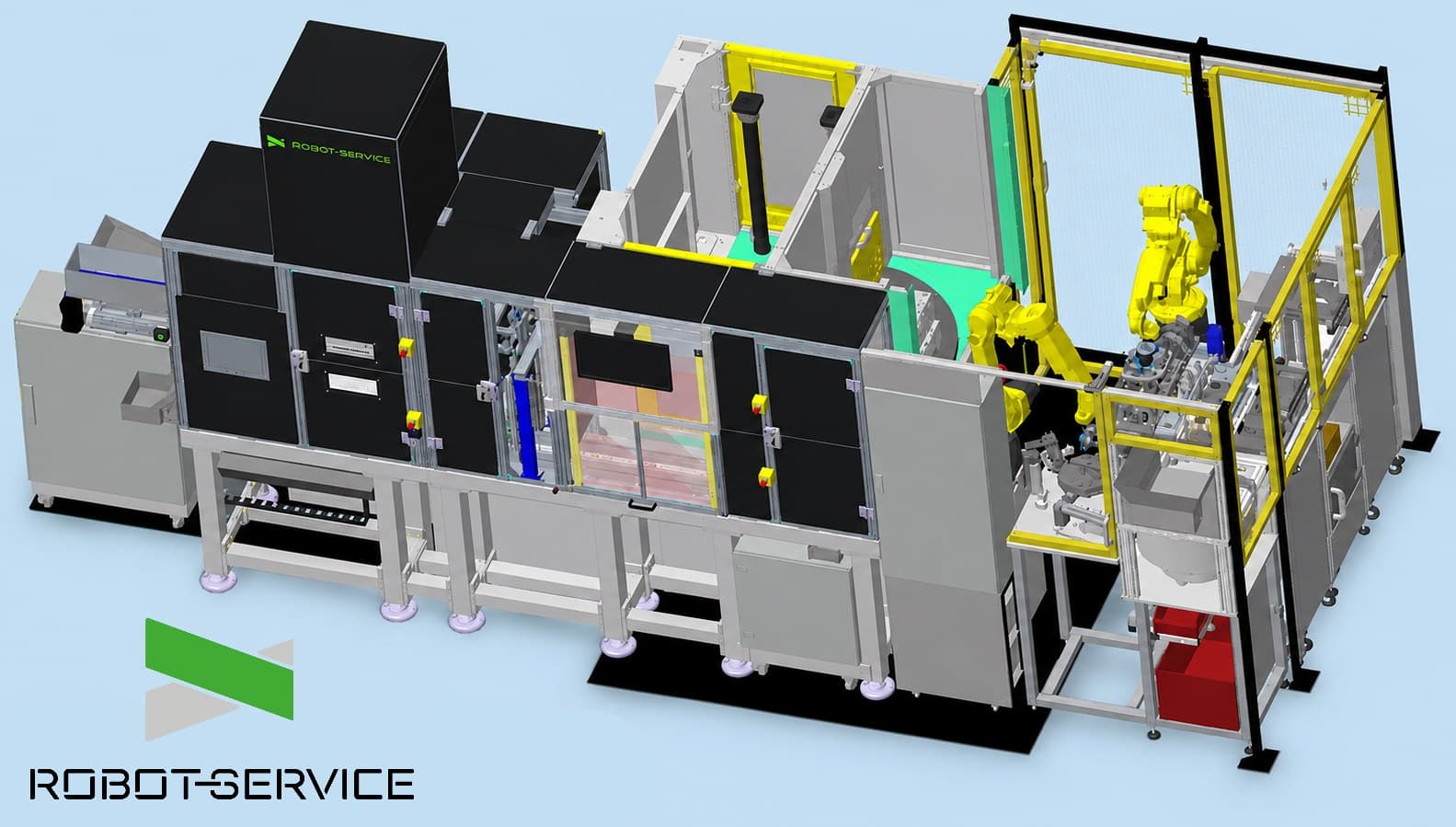
To minimise the risks, we therefore prepared a detailed 3D robot simulation. In the virtual model we precisely reproduced the planned working range, the motion paths and the dynamic parameters.
The simulation clearly proved that a single robot is not able to perform the task with the required stability and cycle time. Based on the analysis, we proposed a two-robot system, which guarantees process safety and long-term operational reliability.
The analysis carried out at this early stage provided the partner with a significant financial benefit:
- Cost prevention: Subsequent rebuilding of the system after installation was avoided.
- Risk management: We prevented an additional investment requirement running into millions, as well as lost production.
- Efficiency: The final specification was already built on the technology actually required, ensuring the project's return on investment.
VI. Summary and lessons learned
The secret of successful automation is balance:
- If the specification is incomplete, functionality will be random, and the faults will only come to light during on-site installation.
- If the functionality is excessive, the return on investment will never materialise.
- If the return on investment has not been calculated thoroughly, the project is a failure in economic terms, even if it is technically perfect.
Practical advice: Do not regard the time spent on the specification as wasted energy. The work invested here can result in significant cost savings by preventing later design and execution errors.
Your partner from design to handover
With decades of experience, the Robot-Service Kft. team helps its customers make automation a predictable process rather than an adventure.
- Technical consulting and specification writing: We help you formulate the URS and FDS documents so that you get exactly what you need.
- Mechanical and electrical design: We lay the foundations for the physical implementation with modern 3D software and standard solutions.
- Robot & PLC programming: Integration of global brands (KUKA, FANUC, ABB) to the highest industrial requirements.
- AI-based solutions: Visual inspection, data analysis
- Service and maintenance: Servicing of industrial and collaborative robots and custom machines
Ready to take the first step?
Involve us as early as the specification phase, and let us look together at how a good specification can make your production more efficient!