
Collaborative Robots and Machine Safety – Why the Safety of the Entire System Matters
Barabás Barnabás ·
The role of CE conformity, risk assessment and ISO 10218:2025 in safe human–robot collaboration
Reading time: approx. 7 minutes
More and more companies choose collaborative robots for their automation tasks, because they enable more flexible production and more efficient human–robot collaboration. Safety, however, does not depend on the type of robot, but on the proper design of the entire system. This approach is the foundation of modern machine safety.
This article explains the role that CE conformity, risk assessment, the ISO 10218:2025 series of standards and the European machine safety requirements play in establishing safe human–robot collaboration – and why using a collaborative robot is not, in itself, enough for a system to be considered safe.
The most common misconception about collaborative robots
With the arrival of collaborative robots, many companies came to believe that this equipment is automatically safe, and that no particular safety measures are therefore required.
The reality is considerably more complex.
The safety of a robot is not determined by the robot alone, but by the entire application:
- the tool
- the gripper
- the workpiece
- the robot's motion
- the operator's workflow
- the environment
Even a robot arm with rounded edges can become a source of danger if it handles a sharp part, presses with high force or moves in an unfavourable direction.
This is why machine safety is always a system-level question.
Robot-Service experience: when the cobot alone was not enough
In automation projects we often encounter the assumption that using a collaborative robot automatically replaces conventional safety solutions.
In one automation project, for example, a customer wanted to set up an assembly station where the operator and the robot work directly next to each other.
The detailed risk assessment revealed, however, that the workpiece handled by the robot could pose a crushing and collision hazard in several situations. The robot did meet the conditions for collaborative operation, but the application as a whole required additional safety measures.
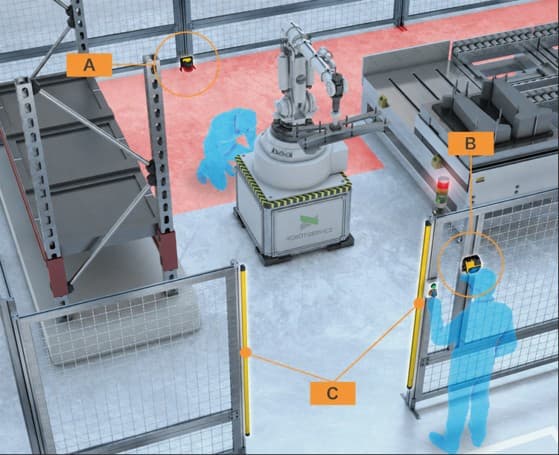
The final system was implemented with a safety laser scanner, speed monitoring and an appropriate workspace layout.
The project was a good illustration that safety is ensured not by a single piece of equipment, but by the careful design of the entire system.
What does CE conformity mean?
Many people think of the CE marking as a property of a product.
In reality, in the case of an automated production system, CE conformity certifies that the complete installation meets the applicable European safety requirements.
This is based, among other things, on:
- risk assessment
- appropriate technical solutions
- safety functions
- documentation
- conformity assessment
CE conformity is therefore not a sticker on the machine, but the result of a documented engineering process.
In the European Union, the conformity requirements for machinery are laid down in the Machinery Regulation (EU) 2023/1230, which replaces the Machinery Directive 2006/42/EC and provides a uniform framework for the safety requirements of modern machines and automated systems. The regulatory environment is continuously evolving, but the goal remains unchanged: to ensure that machines and automated systems can be operated safely throughout their entire life cycle.
CE conformity is not a one-off task, but a process that shapes the design of the system from the very first steps of engineering.
Why is risk assessment crucial?
The purpose of risk assessment is to identify, already in the design phase, the hazards that could cause injury or material damage during operation. The methodology of risk assessment is based on EN ISO 12100, which defines the general principles of hazard identification, risk evaluation and risk reduction. The specific requirements for industrial robots build on this foundation.
Among other things, the risk assessment must examine:
- the relationship between human and robot
- the motion and speed of the robot
- the tool and the workpiece
- the operator's tasks
- maintenance operations
- abnormal operating situations
- mechanical and electrical hazards
- the possibility of unexpected restart
- human–robot interactions
- the adequacy of the safety functions
- the possible effects of control and software faults.
The new ISO 10218:2025 places greater emphasis on functional safety and control logic. A well-prepared risk assessment is therefore not only the basis of conformity, but also significantly reduces the risk of later modifications and unexpected downtime.
What does ISO 10218:2025 require?
The ISO 10218:2025 series of standards defines the safety requirements for industrial robots and robot systems. One of the most significant changes in ISO 10218:2025 is that the safety requirements for collaborative applications are now an integral part of the standard.
As a result, the emphasis is no longer on the "collaborative robot", but on the collaborative application:
that is, on whether the entire system – the robot, the tool, the workpiece, the control system and the operator environment – jointly meets the safety requirements. ISO 10218:2025 also places greater emphasis on the responsibility of the system integrator, since safe operation is not solely the task of the robot manufacturer, but also of the specialists who design and integrate the application. This approach ensures that safety is part of the design process from the outset, rather than a later add-on.
A new approach to collaborative applications
For the design of collaborative applications, the standard defines different modes of collaboration – such as the safety-rated monitored stop, hand guiding, speed and separation monitoring, and power and force limiting – from which the appropriate solution must always be selected on the basis of the risks of the given application.
When designing safety control systems, the requirements of EN ISO 13849-1 or IEC 62061 are typically also taken into account in practice to determine the required performance level (PL) or safety integrity level (SIL).
| Collaborative operating mode | Brief explanation |
|---|---|
| Safety-Rated Monitored Stop | The robot stops safely when a person enters the workspace. |
| Hand Guiding | The operator guides the robot by hand. |
| Speed and Separation Monitoring | The robot's speed depends on the distance to the operator. |
| Power and Force Limiting | The robot operates with limited force so that the risk of injury in the event of a collision is minimal. |
Why do we no longer talk about a "collaborative robot"?
For a long time the term "collaborative robot" was widespread in the industry. The new ISO 10218:2025, however, has brought a change of perspective: it is not the robot that qualifies as collaborative, but the application itself. The same robot may operate safely in a shared workspace in one workflow, while in another application it can only be operated with physical separation. Safety is therefore always determined jointly by the given task, the environment and the protective measures applied.
This change of perspective clearly shows that the focus of machine safety has shifted from the product to the entire application.
Human and robot – safety is a shared responsibility
Machine safety can be illustrated well with an everyday example.
Just as a car is not safe merely because it has an airbag, a robot does not become safe merely because it is of collaborative design.
Together, these form a safe system.
The same principle applies in industrial automation. The robot used in a collaborative application is only one element of the safety chain. Proper design, risk assessment, safety functions and operator training together ensure safe operation.
Safety requires a systems approach
Although at first glance machines and people seem to function in completely different ways, in some respects a surprisingly similar logic can be observed.
Safety is not the result of a single element, but of several layers of protection working together. The same is true for people: we are not protected by a single factor, but by rules, experience, the right tools and conscious decisions together. Industrial automation requires the same mindset.
This is precisely why safety is not a property of a single component, but the result of the proper design of the entire system.
Three key takeaways
- A collaborative robot does not replace risk assessment.
Every application must be assessed individually. - CE conformity applies to the entire system.
It certifies the conformity not of a single piece of equipment, but of the complete machine. - Safety does not hinder production.
A well-designed safety system increases availability in the long term and reduces the risk of unexpected downtime.
How can Robot-Service Kft. help?
Robot-Service Kft. is involved not only in the design and construction of robot cells and automated production systems, but also provides support in developing the machine safety concept, preparing the risk assessment and in CE conformity processes. Our experts support our customers from the design phase onwards, so that automated systems are not only efficient, but also comply with the applicable standards and legal requirements.
Our key services:
- Risk assessment and machine safety review
- Safe design of robot cells and custom special-purpose machines
- CE conformity support and system integration
Further information:
The automated production of the future will not be safe because it uses collaborative robots, but because the entire system is designed with machine safety requirements in mind. Proper risk assessment, the application of up-to-date standards and deliberate system integration together create the safe working environment in which humans and robots can truly work together efficiently.